From Molecule to Market: Bharat Green Hydrogen Summit 2026
Ekansh Sharma · Founder, HyGOAT
Green Hydrogen · India · FICCI
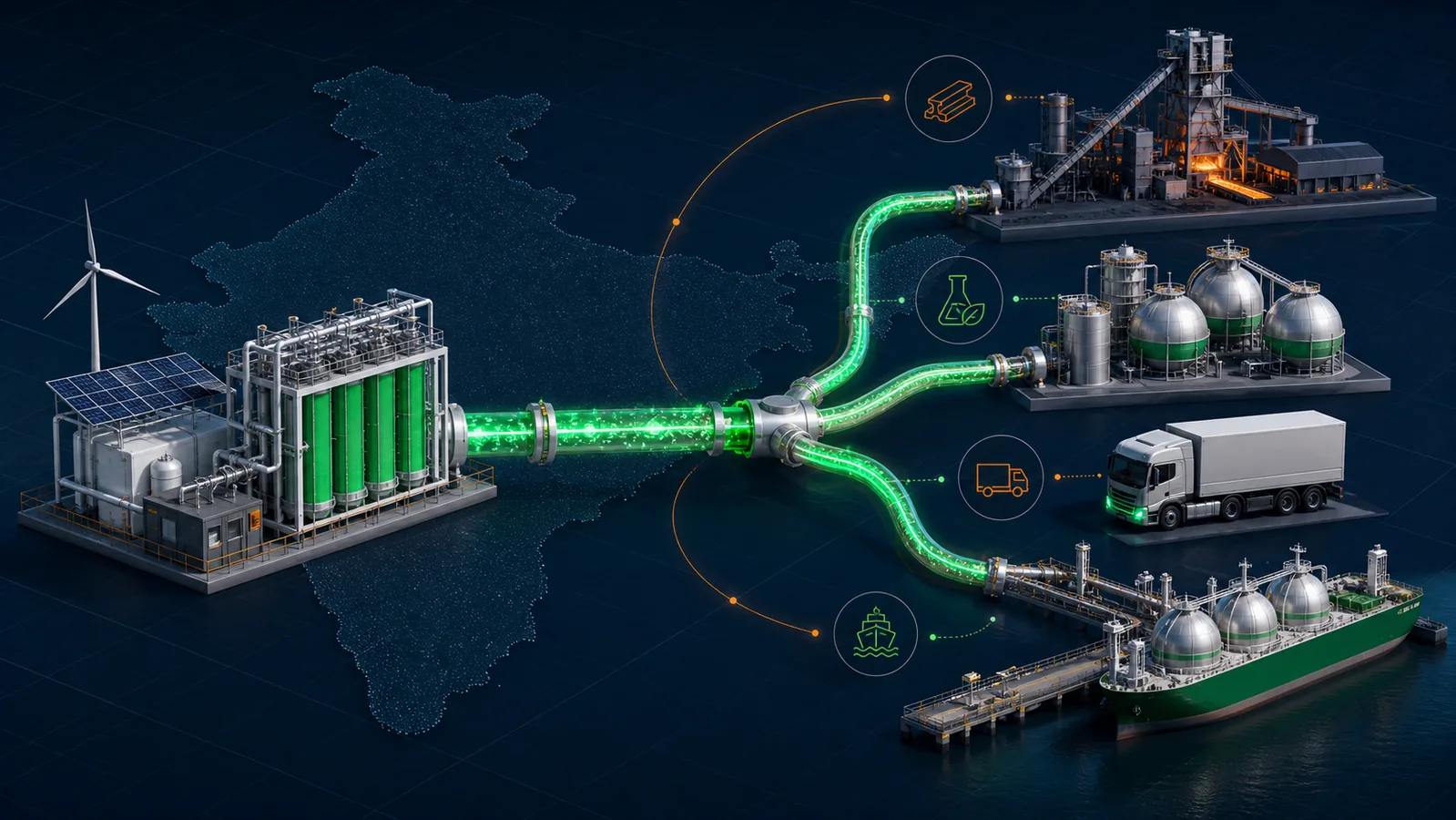
From molecule to market
A 23 July 2026 summit timeline with demand, delivered cost, rulebook, and domestic manufacturing themes.
Demand
Procurement, price discovery, and credible buyers turn targets into a market.
Delivered cost
Pressure, purity, conversion, storage, and transport shape cost at the point of use.
Rulebook
GHCI and RFNBO need separate electricity records and evidence architecture.
Domestic manufacturing
Industrial depth needs stack components, testing, standards, and skills.
The field notes organise the discussion around demand, delivered cost, rulebooks, and domestic manufacturing.
ScopeField-note summary. Room observations remain attributed to the article.
I attended all three afternoon panels at the 2nd FICCI - Bharat Green Hydrogen Summit on 23 July 2026, from the discussion on demand and cost competitiveness through export infrastructure and domestic technology leadership.
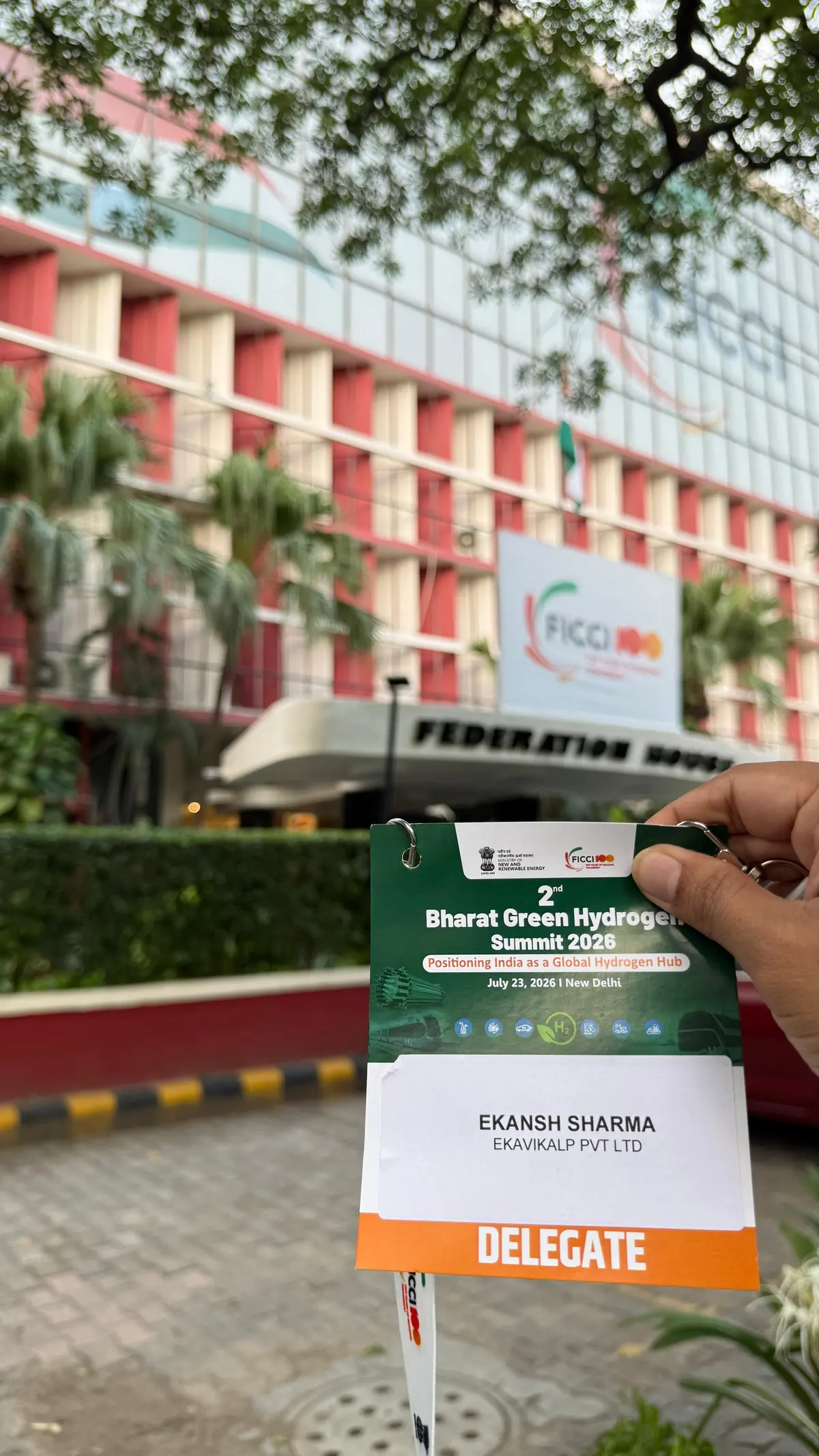
This is not a transcript. It is a set of field notes, checked against public documents where a number, tender or policy milestone could be independently verified. Where the observation comes only from the room, I say so.
The clearest conclusion was that India's green hydrogen conversation has moved beyond production ambition. The harder questions are now more specific: who buys the molecule, in what form, at what delivered cost, against which rulebook, and with how much Indian technology inside the plant?
| The emerging question | What it changes |
|---|---|
| Who is the buyer? | Product, location, volume, tenure and price-discovery route |
| What reaches the user? | Compression, purification, conversion, storage and transport cost |
| Which market rule applies? | Power sourcing, emissions accounting and evidence architecture |
| What is made in India? | Supply security, learning curves, skilled work and durable industrial value |
1. Demand creation is becoming procurement
Joydeep Choudhury of Indian Oil made a useful distinction. Indian refineries already know how to produce, handle and consume hydrogen. The colour labels are classifications of production pathways, not different molecules. The real transition challenge is replacing deeply embedded grey hydrogen and extending low-emission hydrogen use into fertiliser, steel and mobility.
Sujit Pillai of the Ministry of New and Renewable Energy (MNRE) pointed to green ammonia as an early demonstration of domestic demand aggregation. The public record supports the scale of that shift. By June 2026, agreements covered 670,000 tonnes per year across 11 fertiliser plants, after allocations totalling 724,000 tonnes per year. The discovered prices included a low of Rs 49.75 per kg and a weighted average of Rs 53.27 per kg.
Green methanol is next for procurement. In May 2026, the Solar Energy Corporation of India (SECI) opened stakeholder consultation on draft request-for-selection, purchase-agreement and sale-agreement documents for its supply. That is not yet the same as a concluded auction, but it shows SECI adapting the green-ammonia aggregation model to another derivative.
MNRE's Green Hydrogen Certification Portal of India is a separate piece of the market infrastructure. MNRE launched it in July to start reporting under India's domestic scheme. Procurement creates a buyer; the portal aims to help establish what was produced.
2. Integration can matter more than novelty
Naveen Ahlawat of Jindal Steel & Power brought the discussion down to the plant boundary. In my notes, he described hydrogen available directly from the electrolyser stack at roughly 7.5 bar and 99.5% purity, and estimated that avoiding unnecessary purification, compression or conversion could be worth about USD 0.5 to 1 per kg in a steel use case compared with routing the molecule through green ammonia.
Treat this figure as a conference estimate, not a universal benchmark. Its value depends on the electrolyser outlet specification, steel process, distance, utilisation, required storage and the chosen system boundary. The more durable lesson is stronger: compare the cost of hydrogen delivered at the user's required pressure and purity, not merely the levelised cost at the electrolyser gate.
The mobility exchange made the same point from the customer's side. Mahesh P. of Ashok Leyland argued that users encounter a pump price, not a project spreadsheet. Fuel-cell electric vehicles have no combustion emissions at the tailpipe. Hydrogen internal-combustion engines, however, can form nitrogen oxides (NOx) and are not identical to zero-tailpipe-emission fuel cells.
H2-ICE may still be relevant to India's transition. It builds on familiar engine architecture, commercial-vehicle manufacturing and the operating experience created by compressed natural gas. But hydrogen is not CNG: storage pressure, leakage behaviour, materials compatibility and combustion control require hydrogen-specific engineering. The useful comparison is therefore total cost, infrastructure readiness and lifecycle emissions for each duty cycle, not a single technology label.
3. Market eligibility is now a design input
Maxim Schultze-Moderow of GIZ India captured one of the day's most important project-development lessons: developers must select the target rulebook before locking in engineering, procurement and construction choices.
India's Green Hydrogen Certification Scheme uses an emissions threshold of 2 kg CO2 equivalent per kg of hydrogen, calculated over the prescribed system boundary. The European Union's Renewable Fuels of Non-Biological Origin (RFNBO) framework adds detailed tests around renewable-electricity sourcing, including additionality and temporal and geographic correlation, alongside its greenhouse-gas methodology.
These are not two labels waiting to be harmonised into one. A plant can qualify under one framework and still lack the electricity records, contractual structure or time resolution required by the other. That affects renewable-power contracting, metering, storage, operating strategy and capital expenditure.
Gaurav Pundir of the Ministry of Commerce placed standards cooperation, free-trade negotiations and mutual recognition high on the government's trade agenda. My reading is that interoperability and recognition are more realistic near-term objectives than rulebook identity. India and its partners can reduce duplicated assurance, align data definitions and recognise competent assessment, even when their policy criteria remain different.
Soubhik Das of AMPIN Energy Transition made the adjacent point: traceability is not a hydrogen-only problem. Virtual power purchase agreements and energy-attribute instruments already face questions of ownership, cancellation, location, timing and double counting. Hydrogen inherits that electricity-accounting layer and adds conversion and chain-of-custody evidence. Good projects design the data trail with the power architecture, rather than trying to reconstruct it at audit time.
4. Export readiness is physical infrastructure plus long relationships
Souradeep Guha of ACME Group described how the company's recent IHI offtake began with early joint front-end engineering work. His recollection placed those roots in 2022; the public IHI record dates the formal feasibility-study agreement to February 2023. The broader point is unaffected: a bankable cross-border transaction emerged from years of technical and commercial work, not a late-stage search for a buyer.
The relationship has since become unusually concrete. ACME and IHI announced a 405,000-tonne-per-year long-term green-ammonia supply framework in June 2026. Of this, 228,000 tonnes per year falls under Japan's contract-for-difference support and 177,000 tonnes per year under a separate long-term agreement, with supply planned from 2030.
P. Rahul of NTPC discussed Pudimadaka as a multi-product coastal hub rather than a hydrogen-only plant. NTPC's published project concept includes green hydrogen alongside methanol, ammonia, urea and sustainable aviation fuel, supported by storage, transmission and port infrastructure.
A tender issued on 22 July 2026, the day before the summit, adds a tangible infrastructure marker. The package combines a 10 million-litres-per-day water-treatment plant, firefighting systems and a 132/33 kV gas-insulated substation, with two years of operations and maintenance and a 70% local-content threshold for Class-I local suppliers. This demonstrates active procurement.
5. Localisation must move inside the stack
Arjun Mehta of Hydgen and Braj Nandan Singh of Waaree Energies brought the conversation from capacity announcements to manufacturing depth. India gains less if domestic electrolyser manufacturing stops at assembling imported stack technology with local balance-of-plant equipment. The harder industrial task is to develop electrodes, catalysts, membranes, membrane-electrode assemblies, stack engineering, testing capability and the supplier clusters around them.
The policy base is no longer small. Under the Strategic Interventions for Green Hydrogen Transition (SIGHT) programme, the government has awarded incentives to 15 companies for 3,000 MW per year of electrolyser manufacturing capacity. The next measure of success should be local value addition and performance in core components, not nameplate assembly alone.
Prof. Chitra Rajagopal's intervention connected this industrial ambition to safety. Her message, as I recorded it, was to bring safety and standards into development by Technology Readiness Level 3, when architecture can still change cheaply. This matters because the Bureau of Indian Standards' June 2025 document on efficiency assessment for alkaline, proton-exchange-membrane and anion-exchange-membrane electrolysers is still a draft standard, not a final one. Start-ups should nevertheless expect comparable efficiency evidence to matter to buyers, financiers and future conformity assessment.
6. The workforce question needs an inspectable model
Sweta Bhattacharjee of the National Skill Development Corporation described work to anticipate the scale and type of upskilling required for India's 5-million-tonne ambition. Public mission estimates point to more than 600,000 jobs by 2030, but a national headline is not a hiring plan. Developers need occupation-level answers by technology, project phase and cluster.
That is the purpose of the open-source India H2 Workforce Atlas, which I shared with her after the session. It maps 1,802 National Career Service occupations and provides scenario, gap and reskilling views. It is an indicative research tool, not an NSDC forecast or endorsement, but its method is inspectable and can be challenged or improved.
What the afternoon added up to
Five conclusions stayed with me:
- Demand needs a contract shape. Targets become markets through aggregation, price discovery, tenure and credible buyers.
- The relevant cost sits at the point of use. Pressure, purity, conversion and logistics can outweigh novelty at the production site.
- Eligibility must enter before EPC lock-in. GHCI and RFNBO preparation can change power contracts, operating logic, evidence systems and CAPEX.
- Infrastructure and capability must mature together. Ports, water, substations and storage matter alongside stacks, components, standards and skills.
- Traceability is industrial plumbing. It is not a paperwork layer to add after commissioning.
India is moving through the difficult early phase of building a new industrial system. The summit's best contributions did not pretend that one price, one molecule or one standard would settle the transition. They showed where the interfaces now sit. That is where cost leaks, evidence gaps and bankability failures accumulate, and where the most valuable work remains.
For project teams testing those interfaces, HyGOAT SCREEN provides an indicative view of RFNBO export readiness or GHCI preparation gaps before formal external review.
Sources and further reading
- MNRE: National Green Hydrogen Mission
- MNRE: Green Hydrogen Certification Scheme of India
- PIB: GHCI portal launch and National Green Hydrogen Mission progress, 17 June 2026
- SECI: stakeholder consultation on green methanol procurement documents
- EU Delegated Regulation 2023/1184 on RFNBO electricity sourcing
- EU Delegated Regulation 2023/1185 on greenhouse-gas methodology
- US Department of Energy: hydrogen combustion and nitrogen oxides
- GHG Protocol: Scope 2 Guidance
- BIS: draft efficiency-assessment standard for water electrolysers
- IHI: India-to-Japan green-ammonia feasibility agreement
- ACME: 405,000-tonne-per-year IHI supply framework
- NTPC: Pudimadaka Green Hydrogen Hub project concept
- NTPC tender archive
- India H2 Workforce Atlas: source code and methodology
The descriptions of panel interventions rely on the author's conference notes and recollection. Public documents are linked wherever a factual milestone could be independently checked. The USD 0.5-1/kg integration figure is a speaker estimate whose assumptions were not published in the summit materials.